

It has been a dismaying half-decade of discovering that a very large number of people who hold strong opinions on political topics do so without even the first notion of whether there are facts to support that opinion. If we were back in the 1700’s when we were entering into a new world of experimentation in democracy, there wouldn’t be a lot of history to draw upon to inform us what worked and what didn’t. Our founding fathers, who were certainly informed by what didn’t work in the autocracies of the Old World, had opinions on what might work, but they had never been tried out. Now, in the 21st century, we have a long history filled with data to draw from as well as unprecedented abilities to analyze and share information as to what works and what doesn’t. Even so, we have what amounts to pervasive ignorance on the facts. If the ignorant were self-aware and admitted that they just aren’t informed, that would be one thing. Unfortunately, it’s all too often the case that people not only have no explainable reasoning behind their beliefs, but they’re entirely comfortable with this arrangement.
Having read this far, I trust that you, dear reader, are with me in an endeavor to improve on this. We will recognize the difference between personal preference and matters of fact. If we are to adopt a belief on matters of fact, we will ensure that it is based upon a foundation of credible evidence. We are not going to allow ourselves to fall prey to the politicization of pure science, and we are going to ensure that we have a well-balanced diet of news consumption.
That’s a great start, but it doesn’t end there. Ideally, we would enter the news consumption world with a blank slate, filling up our knowledge base with information grounded in facts from credible sources. This will inevitably evolve into developing beliefs about the various topics you’re exposed to. With those beliefs established, it is incumbent upon us to continue to challenge those beliefs by exposing ourselves to differing points of view. Engage with people who disagree with you. Subject your beliefs to the scrutiny of those who would love to change your mind. Share ideas and points of view that challenge each other. If you emerge from such scrutiny with your beliefs still intact, you can be assured that your beliefs rest on a solid foundation. If, however, you encounter a set of facts that contradict your beliefs, you are duty bound to change your views to incorporate this new information. This is NOT an easy process. It is filled with conflict, and being forced to change your views takes a fair bit of humility that is not easy to summon.
What I just described in this last paragraph is the application of the Scientific Method on political science topics. Again, just to review:
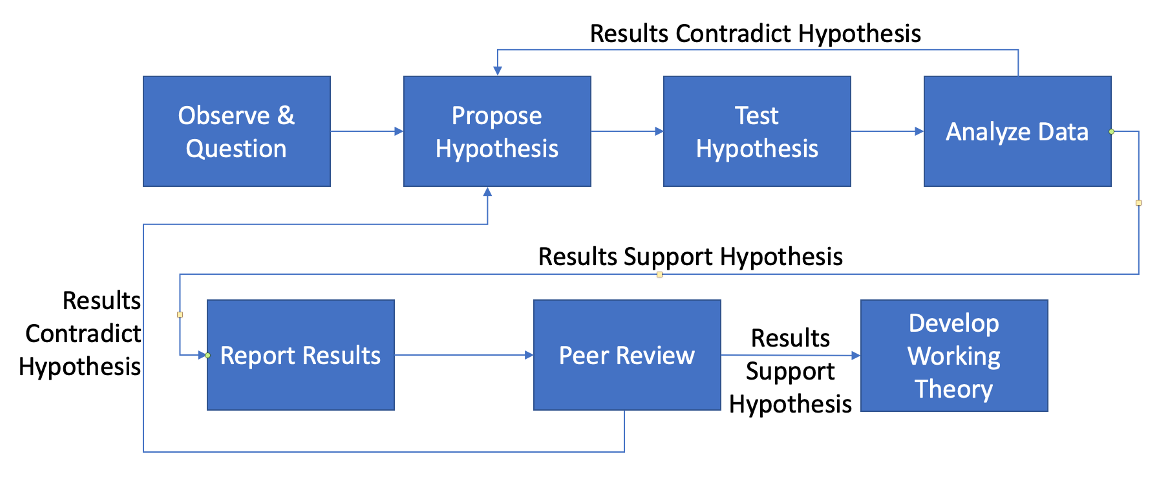
The process starts in the moment of observing something that raises a question. Something like, “I feel like I am unable to fully live out my religious beliefs. I wonder if it’s just me, or is this a pervasive issue in this country?” This would then lead someone to form a hypothesis of “Religion in America is under attack,” and then go about testing the hypothesis. If the testing produced data that contradicts the hypothesis, then one must conclude that the hypothesis is false, and formulate a new hypothesis that fits the observations from the test. If after repeated testing, a hypothesis persistently withstands scrutiny, one should feel free to adopt that hypothesis as a belief.
Fittingly, a right-wing Facebook site posted the results of a poll that said many people feel that religion is under attack in America. This prompted a myriad of comments strongly stating that this was not just a fact, but obvious! I took this opportunity to gain a deeper understanding of why they felt this way. After all, an attack on religious freedom in America isn’t simply a matter of preference. This is something that should be able to be proven with an abundance of credible evidence. I responded to their comments with a simple request: “I’m sincerely curious why you feel this way, but I must admit, it’s not obvious to me why this is. Can you provide some examples that illustrate how Religion is under attack in America?” The majority of times, I was either simply ignored, or met with a cop-out along the lines of “if you can’t see it, that’s not my problem. Do your own research” thereby avoiding having to produce factual evidence that supports their view. On the rare occasion when I would get a substantial response, it inevitably centered on the notion that this country was “founded as a Christian nation” and the elimination of God from our society – especially in the form of prayer in public schools – is an attack on religion. Without delving into the validity of the response, I have to give these minority of folks at least some credit for actually being able to produce an example that supports their belief.
After acknowledging that many of our country’s founders were in fact Christians fleeing religious persecution in Europe, I pointed out that they were keenly aware of the need to avoid replicating religious persecution here. They recognized the hypocrisy of being persecuted for their religious beliefs in England, only to turn around and persecute someone else in America for not sharing their beliefs. I’d then ask them what they believed is meant by the first clause of the First Amendment:
Congress shall make no law respecting an establishment of religion…
In that moment, if they were giving it any depth of thought, they should have felt the cognitive dissonance of being confronted with the fact that their beliefs were contradicted by the First Amendment. How does one reconcile the fact that the Constitution explicitly prohibits the establishment of a state-sanctioned religion when you believe that the country is founded as a Christian nation? I often took the opportunity to spell it out for them. They have three options:
Produce evidence that rebuts the argument I just made. How does the First Amendment not apply here?
Abandon your previous belief and adopt a new one that is consistent with this new information. Maybe this country wasn’t actually founded as a Christian Nation, and by extension, religion isn’t necessarily under attack in this country?
Maintain your current belief and continue living in denial of the fact that existing evidence contradicts your beliefs.
It should come as no surprise to the intuitive reader that when we reached this point in the social media debate, my counterpart chose Option 3. EVERY time. They clearly were incapable of Option 1, and it is apparently more important that they maintained their current belief system than to ensure that it is consistent with all known facts.
As scientists, we are trained to follow the Scientific Method, which engrains in you the awareness that at any given moment, that which you believe may be proven false. This is not a traumatic moment, or a sort of failure. It is to be celebrated! If credible & repeatable test results show that the prevailing understanding of the world around us is false, why would we ever want to continue to hold onto those crippled beliefs? It’s time to cast them off and adopt better beliefs! No need to be shamed for having held on to flawed beliefs. At the time, they were the best available. Now, we know better. Put the past in the rear-view mirror and move forward with confidence of having a more defensible view on things… until the next conflicting test result comes along, and we’re back to adopting the next best description of the world around us. This is the way of science. We once believed that Uranus was the last planet in the solar system. Then we gathered data that contradicted the expected motion of the orbiting planet, and with that intuition, we discovered another planet! With this knowledge, who wants to deny Neptune’s existence just so that they can continue to believe that Uranus is the planet farthest from the sun? Why would one do that???
Yet, that happens every day in the political world. They’ve come to believe that, for example, the country is a Christian nation, which opens the door to enacting laws that are fundamentally religious in nature. I get it. If you’re strongly religious, wouldn’t it be grand to be able to pass federal laws that reflect your religious beliefs? But then they come to realize that the First Amendment doesn’t allow for that. We CANNOT enact laws that are fundamentally derived from religion. It’s time to come to terms with that, and move on, knowing better. Maybe I’ve interacted with a substandard crowd over the past five years, but in that time, I’ve seen zero evidence that this is practiced in our society.
This must change if we are to fulfil the calling of the Preamble of the Constitution: to strive to form a more perfect union. How can we possibly achieve this if we are so arrogant as to act as if maintaining our own individual beliefs is more important than acknowledging that which is both proven to be true, and contradictory to our beliefs? To live up to the challenge of being an informed citizen of the United States, we are obliged to adopt the Scientific Method for Political Science:
The (Poli-) Scientific Method.
What follows in this book is an analysis of the common arguments used in some of the major political issues being wrestled with today to see how well their beliefs stand up to the scrutiny of the (Poli-) Scientific Method. Arguments that have contradictory evidence from credible sources are to be discarded, and all that remains will be summarized as a Working Theory. It’s my duty to substantiate all the non-obvious points with citations from credible sources that provide the supporting factual evidence. I’ve deliberately limited my writing to that which can be supported by public domain information on the internet. This book is meant to be an illustration of the sort of research that should be done when people say, “do your own research.” Even though that has become a sort of cult scripture, it’s not bad advice – so long as you do it responsibly.