

Now that we’re in the business of actually considering the available facts… do we actually do so? Unfortunately, my time on social media over the past five years suggests otherwise. As previously mentioned, my quest to understand those who hold beliefs diametrically opposed to mine has me seeking out conversations with them. Wading through right-wing posts, I find someone who makes a definitive statement that that is wildly different from my point of view. I didn’t tell them they’re wrong. Rather, I simply asked them to provide examples to back up their statement. In the vast majority of cases, the other person had nothing to offer in the way of substantiating evidence that supports their original statement. One such exchange on whether the 2020 presidential election was rigged illustrates this in excruciating detail:
Them: You claim there were 60 cases brought forward with 0 evidence of fraud. That came from your not so trustworthy MSM[1]. Just another one of their many lies! How could anyone support a sick pedophile who’s [sic] intentions are to destroy the USA as we know it?
Me: MSM lied about Trump losing 60 law suits? Again with the unsubstantiated claims. You know how I'm going to respond... DO YOU HAVE EVIDENCE? On what basis do you say this? Pedophile??? On what factual basis do you make this claim?
Them: It’s impossible to bring forth the evidence of the fraud when MSM is covering for the deep state! Just because they are hiding the facts, doesn’t make it false information! It just means I personally cannot prove it to you at this point in time! It’s fine with me that you choose to believe what you believe! It is your right to! Just as it is my right to believe what I choose to believe!
Me: If you have no facts on which to base your beliefs, why do you believe it, in contradiction of all the available evidence that suggests otherwise? Most telling… “I choose to believe.” Why??? You firmly believe that the MSM is lying to you, but you don't have actual evidence of it. How are you so confident???
Them:
This is about when conversations like this typically come to an abrupt end.
This example raises the final hurdle in our way of pursuing a structured process of determining political truths: The advent of “Fake News” and “Alternative Facts”. The individual above has clearly has insulated themselves from having to deal with facts that conflict with the world view they’d like to have. When you get your news from partisan sources that stroke your confirmation bias, there’s no conflict. The mainstream media, however, is prone to broadcasting some uncomfortable facts.
Is there bias in the mainstream media? For sure. It’s everywhere. The days of Walter Cronkite delivering a factual foundation that everyone accepted as truth are long gone. The public’s trust in news organizations has eroded considerably over the decades. Fox News is clearly biased toward the right; MSNBC is biased toward the left. The bias shows up not so much in terms of broadcasting lies as in what is not broadcast. Facts presented without appropriate context can produce misunderstandings that lead to false conclusions. For example, are you aware of the fact that the amount of snow in the Antarctic has actually increased over the past few decades?

What happened to global warming?!?! I thought all the glaciers on Earth were melting??? Check out the first two sentences of this article. Without any further context, it looks like NASA is contradicting those fear-mongering climate change fanatics!
Of course, this story begins with a nugget of truth: snow has, in fact, been increasing in the Antarctic over the past decade. One of the reasons why “global warming” has been replaced with “climate change” is that it avoids the confusion illustrated in this example. The global average temperature is increasing. That is not in dispute (among rational people). This does not mean that the change is occurring uniformly everywhere. Some places will get much warmer. Others may actually get colder. Dry places will become wet. Wet places will become dry. A warmer planet will produce different climate patterns, including more snow in the Antarctic. This isn’t actually all that surprising. Anyone who lives in snowy places understands that you get larger snowfalls when the temperature is in the upper 20’s or low 30’s. When the temperature drops really low, the amount of moisture the air can hold drops precipitously, and there just isn’t enough water in the atmosphere to produce a major snow event. So, if the Antarctic warms up from super-cold to less cold, but still below freezing, it should come as no surprise that they may see an increase in the amount of snowfall.
So, the Antarctic getting more snow is entirely consistent with Global Warming. It took me 188 words, and involved a bit of science. For those who are ambivalent on the topic, or worse, skeptical, what are the chances that they’re going to go through the effort to seek out this truth? If they happened across such an explanation, would their attention span stay engaged long enough to catch the entire explanation? Unfortunately, the answer is no for most people. Small soundbites are far easier to digest than long explanations. Complicated topics, like nearly everything of consequence in American politics, is not adequately covered in small soundbites. It requires nuanced and detailed consideration. This is all the crack in the door that ignorance needs to force its way in. Why go through the effort to seek out information that might contradict my beliefs when I can just marinate in the comfort of biased “news” that confirms my existing beliefs?
Just to prove that I’m not just picking on Fox News, it’s not hard to spot the bias in MSNBC as well. Pew Research has frequently conducted analyses illustrating the tone various networks take in covering stories like a presidential election. It’s pretty clear from the following charts that you’re much more likely to find MSNBC broadcasting a positive story about the Democratic candidate than a negative story. Likewise, you’re likely to hear more negative stories than positive stories about the Republican candidate. Now, that by itself is indeterminant. Maybe the Democratic candidate is deserving of the praise and the Republican candidate is deserving of criticism. The truly telling analysis is comparing MSNBC to other networks:
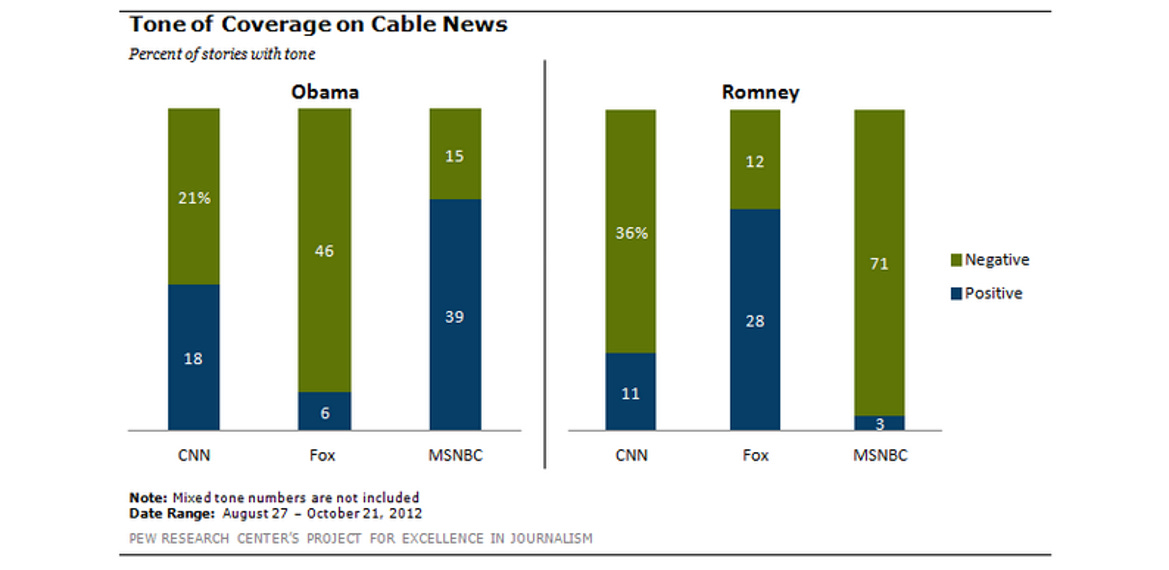
Clearly, the news you hear will vary by the sources of information you pay attention to. How do you ensure that you’re getting a well-rounded and accurate account of what’s actually going on? There’s a great chart published by ad fontes media called, appropriately enough The Media Bias Chart that organizes a variety of news outlets in terms of their political bias (left vs right) and their reliability (Facts vs opinion vs misinformation):
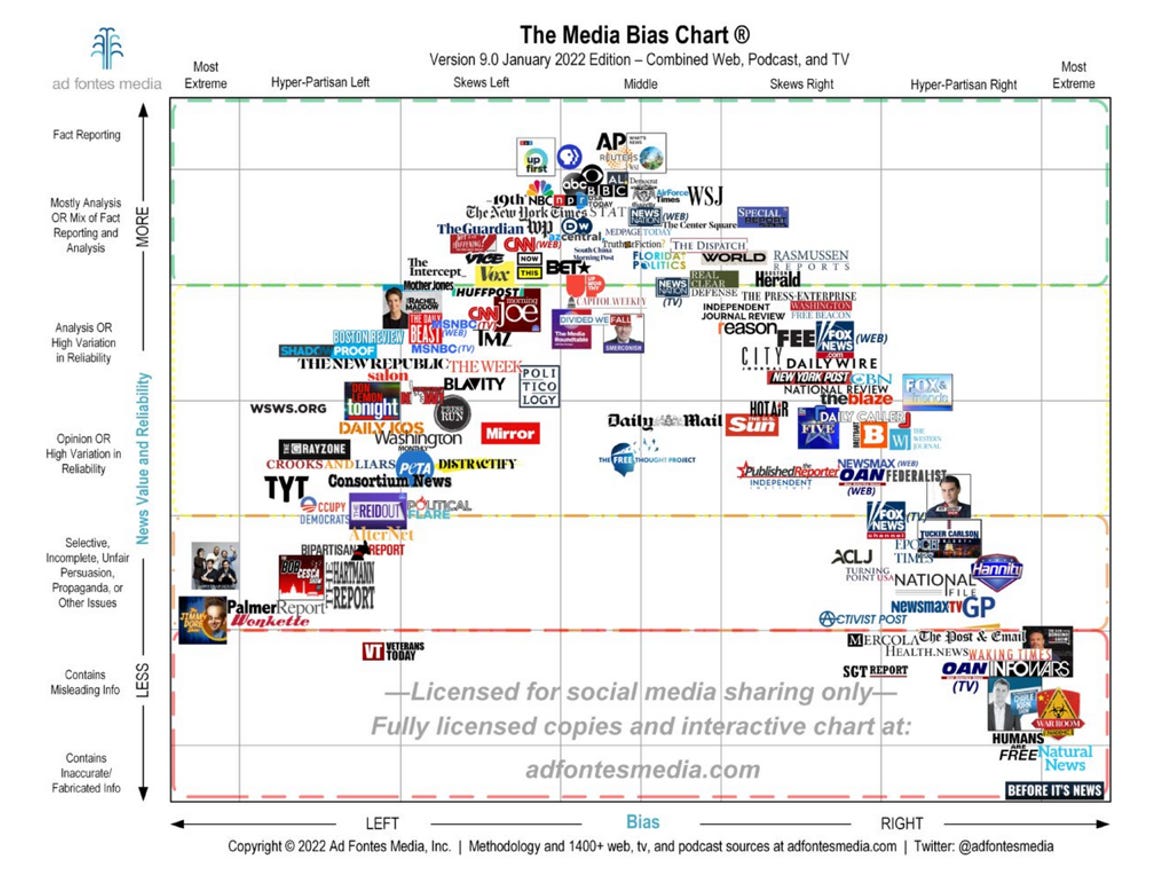
If you find that you are predominantly getting your information from the lower half of this chart, that should be a huge warning sign that you are prone to being misinformed. If your viewing habits are consistently on one side of the chart, you are prone to getting only part of the story.
Bias in the media by isn’t inherently a problem. The problem arises when coupled with a psychological phenomenon known as “In-Group Bias”, where one is more likely to believe information coming from a source from within your “group” than you are to believe that coming from outside your “group”. The term has its origins from a couple of studies by psychologists. In 1973, Michael Billig and Henri Tajfel had random people evaluate paintings. Some of the participants were told they had been assigned to a specific group based on the paintings they had indicated they preferred. They were given a code number for their group. Others were told they were assigned to a group, along with their code number, at random. The control group weren’t placed into a group. In classic psychological testing methodology, this experiment focused the participants attention on the paintings, when the real experiment was on the code. The participants were then provided an opportunity to award other participants money, but they were only identified by their group’s code number. Would people give more money to people in their own group? Would the amount they gave depend on how they were placed into the group (by painting preference, or by random)? Unsurprisingly, people gave more to people in their own groups. Interestingly, it didn’t matter how they were placed into their groups – merely that they were part of the same group.
When people with strong political views watch news broadcasts from networks that present information biased toward their political perspective, they self-identify as being part of the “in-group” and naturally tend to believe what is being presented. Rather than holding a healthy level of skepticism to parse out that which is based in fact from that which is being spun to fit an agenda, they simply accept it without scrutiny. Now, throw into the mix another psychological phenomenon: Confirmation Bias. People not only resonate with information that matches their existing beliefs, but actively seek out sources of information that will match those beliefs. The recognition of this bias in human reasoning dates as far back as the ancient Greeks. The hero of the previous section above, Francis Bacon, wrote:
The human understanding when it has once adopted an opinion ... draws all things else to support and agree with it. And though there be a greater number and weight of instances to be found on the other side, yet these it either neglects or despises, or else by some distinction sets aside or rejects in order that by this great and pernicious predetermination, the authority of its former conclusions may remain inviolate.
Interestingly, we’ve recently gone through a period of time that tests the power of in-group bias and confirmation bias. Prior to the 2016 election, Americans of all stripes were unified in their opinion toward Russia. After the fall of the Soviet Union, it looked like there might be some opportunity to cooperatively work with a newly democratic Russia. But When Russia invaded Crimea in early 2014, the American public soured in their views. In 2014, only 22% of Republicans viewed Russia as an ally. Similarly, few Democrats viewed Russia favorably. But by 2018, something happened to only Republicans, prompting support to bounce up to 40%. What could possibly account for Republicans to break from Democrats in our united views toward this foreign adversary?
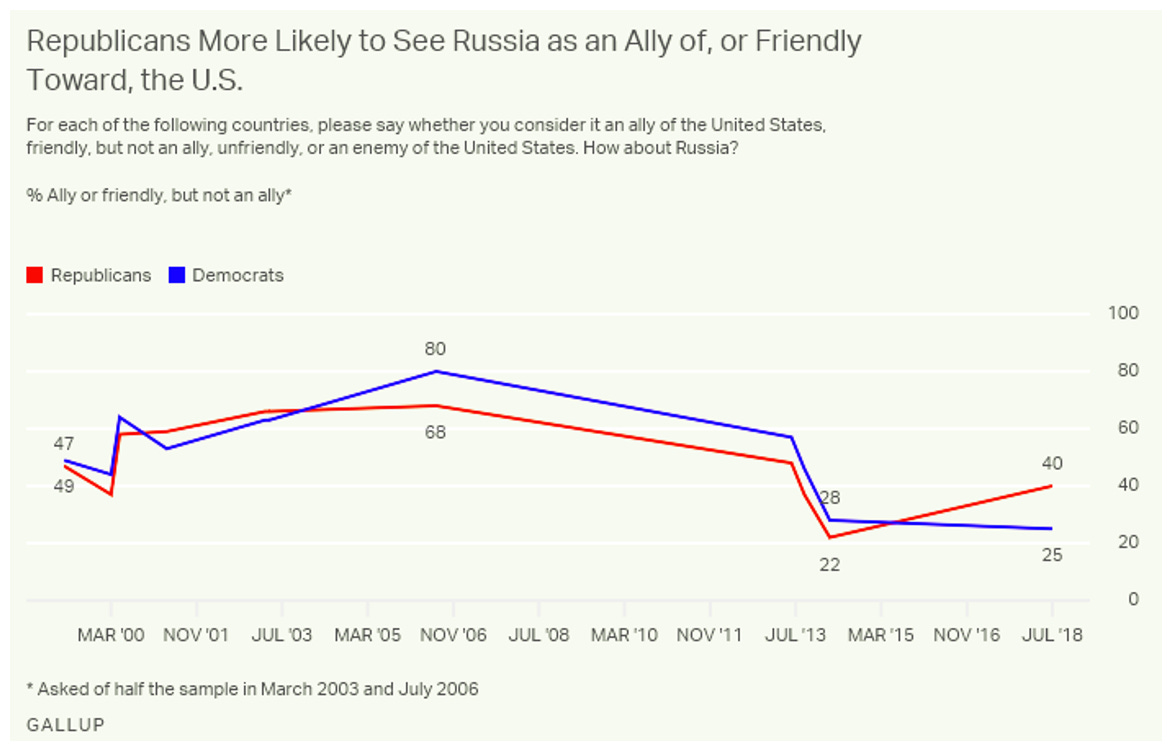
As Trump started climbing the polls in the 2016 primaries, his overt subservience toward Russia created an interesting dynamic for the Republican Party. On one hand, the Republicans have traditionally been more suspect of the Russians than the Democrats. Their patriotic opposition to communism under President Reagan translated into a mistrust of Russia. An ascendant Trump’s warmth toward Russia would surely conflict with any notion of Confirmation Bias. However, other issues clearly carried Trump to the top of the heap, and along with it came the In-Group bias of his message. Once Trump became president, and the undisputed leader of the Republican Party, once long-held skepticism toward Russia washed away. The “Better Dead than Red” party became the “I’d rather be Russian than Democrat” party. In the tug-of-war over the hearts and minds of Republicans, apparently In-Group Bias was more potent than Confirmation Bias. Huge swaths of the Republican electorate changed their views toward Russia – not because of anything Russia did to ingratiate itself with Republicans, but simply because Russian-loving Trump became their president.

Bacon recognized that the Scientific Method would only be successful if we made a conscious effort to be aware of the biases that we are all prone to, and actively work to overcome them. One must make a deliberate effort to not fall prey to our natural tendencies that will cloud our ability to make rational judgements and view the facts truly as they are.
In a democratic society, where the people are empowered to decide the leadership that determines the path we will follow, it is critical that the populous be accurately informed of the issues of the day. If we are to have an accurately informed populous, it is critical that we consume our news not from a single source, but from a diverse array of sources. Read multiple stories on the same topic to ensure that you’re getting the full picture. Avoid the sources that are known to peddle in not just biased information, but misinformation. Be cognizant of the biases that we are all prone to having, and deliberately work to overcome them. These are the fundamentals to ensuring that you are getting accurate information, so that you can be confident in forming opinions on matters of fact. But this is not easy. In-group bias and confirmation bias are both real and strong. It’s very reassuring to be part of a group and to have what you believe echoed back to you. News watching has become for many like watching Pro Wrestling. You’ve got your good guys and your bad guys. When the bad guys are beating up the good guys, it’s harrowing, but there’s few things more satisfying than watching the good guys giving it to the bad guys. It all makes for great TV, but a poorly informed populous. We must choose as a society to forego the dopamine-inducing snuggy of confirmation bias that our favorite biased news network provides and ensure that we have a grip as to what is actually going on. Otherwise, we’ll end up, without even the slightest sense of irony, “choosing to believe” what we want.
[1] Mainstream Media